
Listen Now: Experience This Article with Avi's Soothing Voice
Nishchaya and the real architecture of becoming
There are two of you.
There is the one reading this — the one with the wish, the ache, the half-formed picture of a life that is not yet here. And there is another, standing just out of view: the one who already lives that life. Who already has the body, the work, the steadiness, the thing. That second self is not a fantasy. They are entirely real. The only thing separating you from them is distance — and distance, unlike fate, can be crossed.
Everything we mislabel as manifestation is really just this crossing. Not a summoning. Not a spell whispered to a generous universe. A crossing, on foot, from the one who wants to the one who is.
We have been taught to believe the gap closes by wanting hard enough — that if we picture the far self vividly and hold the feeling long enough, it will drift toward us of its own accord. It never does. Wanting is motion in place. The second self does not come to you. You go to them, one chosen step at a time, until the day you glance down and find you are wearing their life as your own.
The second self does not come to you. You go to them.
The crossing begins with a single inward act the yogis called *Nishchaya* — a certainty so settled it ends all argument with yourself. Not a wish, not a goal, not a New Year's vow that frays by February. Decision still leaves the door open for debate; Nishchaya closes the door. It is the moment you stop asking whether to become that second self and begin asking only how. Before it, you are browsing your own life. After it, you have set out.
This is why a true Nishchaya is so rare, and why most of us circle one for years without ever making it. A real decision is a kind of small death. To say a wholehearted yes to one life is to say a thousand quiet noes to all the other lives you might have led — and we are reluctant mourners, unwilling to bury the comfortable fiction that we can still become anyone at all. So we keep our options open, which is only a gentler way of saying we never truly choose. Nishchaya is the willingness to let those other lives go, so that one of them can finally become real.
You do not attract the life you want. You become the person who lives it.
But you cannot cross a distance you refuse to measure. So the first honest act after the decision is to stand still and look — clearly, without flinching — at exactly where you stand: your true resources and your real deficits, your habits, your fears, the skills you genuinely have and the ones you only pretend to. Most people will dream all night and never once take this measurement, because the measurement can wound. Yet it is the kindest thing you can do for yourself. A doctor who flatters the X-ray helps no one. The gap between your two selves becomes crossable only in the moment you are willing to see how wide it truly is.
There are two ways to lie to yourself here, and both are fatal. The first is to shrink the gap — to tell yourself you are nearly there already, that only a little luck stands between you and the far self. This is the comfortable lie, and it ensures you never pack for the journey. The second is to magnify the gap — to make it so vast and so steep that no first step could possibly matter, and the only honest response is to stay home. This is the despairing lie, and it ends the crossing before it begins. Truth lives between them: the distance is real, often greater than you hoped, and crossable anyway. Hold both halves of that sentence at once, and you are ready to move.
The becoming was never the means to the reward. It was the reward.
Then you choose a route — and here is where most journeys quietly die, strangled by their own rigidity. A route is not a contract the world has signed. It is a best guess, drawn in pencil, certain to be redrawn. The ground will shift. Bridges you were counting on will be out; paths you never noticed will open in the dark. To insist on one fixed road is to mistake the map for the journey.
Hold the far self with iron. Hold the route with an open hand.
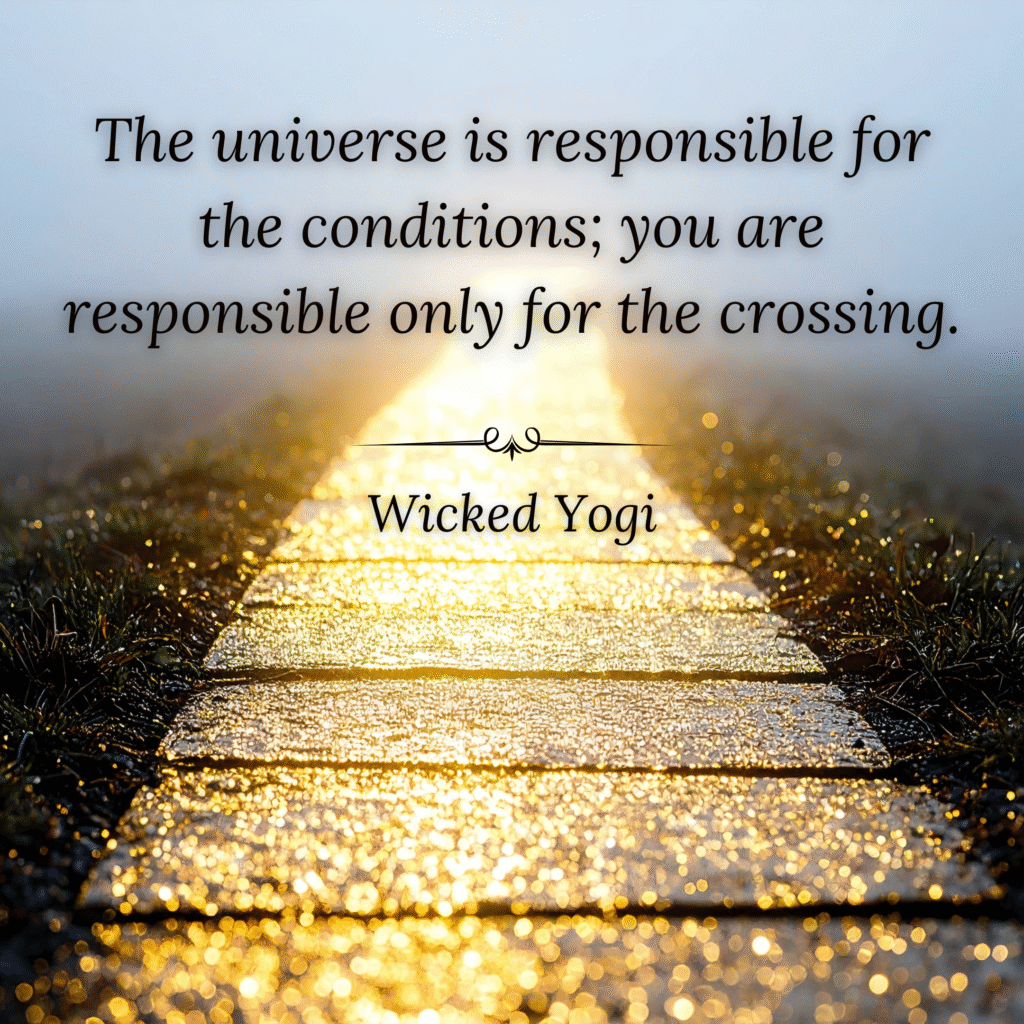
What actually carries you across, though, is none of this. It is the single thing in all of existence that is wholly, inviolably yours: your next action. The universe is responsible for the conditions. We are responsible for the choices. Within that narrow but sacred space between what happens to us and how we respond lies the entirety of human freedom. The universe may dictate the circumstances, but it cannot dictate our actions, our reactions, or the meaning we assign to either.
Our sovereignty begins and ends with choice.
Two travellers meet the same washed-out road; one turns back cursing his luck, the other shoulders his pack and finds the long way around. The obstacle was shared. The step was not. And every step is a choice, taken or refused, dozens of times a day.
And there is one freedom that survives even when the road runs out entirely — when illness pins you to a bed, when grief takes the person you cannot replace, when every outer door is bolted at once and there is genuinely nothing left to do. In that moment the freedom of action is gone, but the deepest freedom remains untouched: the meaning you assign to what has befallen you. The same loss can become the thing that breaks a person or the thing that deepens them, and which it becomes is not decided by the loss. It is decided by you. The conditions were never yours to choose. The response always was.
And this is the secret the whole crossing turns on — the part no spell can counterfeit. Each step does not merely carry you forward. It changes who is taking the next one.
Our sovereignty begins and ends with choice.
Walk far enough as someone who chooses the nourishing meal, the early night, the unglamorous hour of effort, and somewhere along the road it stops being a thing you make yourself do. The friction quietly vanishes. You are no longer a person forcing themselves toward health; you are simply a healthy person, doing what such a person does. It is the same quiet alchemy as learning to cook a dish you will go on to make a thousand times. In the beginning you stand anxious over the recipe, measuring every spice, second-guessing the heat, checking and rechecking that you have it right. Then one ordinary evening you realise you have not looked at the recipe in months — that your hands already know the weight of the rice, the moment the oil is ready, the turn of the flame — and what was once an effortful task has quietly become something you simply are. A person who cooks. Nothing was added but repetition.
Repetition is how the far self stops being far.
Step by step, you are not approaching that second self. You are becoming them — and the becoming compounds. The earliest steps are the steepest, because each one is a vote cast for a person you are not yet; you are walking uphill against the gravity of your old identity, and every choice must be paid for with willpower. But the further you go, the more the ground levels. The choices that once cost you everything begin to cost you nothing, because they are no longer choices against your nature — they have become your nature. What began as discipline ends as instinct. This is why the first mile is so much harder than the last, and why so few people ever discover how easy the later miles become: they turn back before the road flattens.
For there is a long, unglamorous stretch in the middle of every crossing that the wishing-doctrine never warns you about — the season after you have left the old self behind but before the new one has anything to show for it. You are doing the work, and the world has not yet answered. The scales have not moved, the manuscript is unfinished, the venture is still only expense. This is where the old voice creeps back to whisper that it isn't working, that you should picture harder, wait for a sign, abandon the road. But the absence of visible fruit is not the absence of progress. A seed splits open and sends its first root downward in total darkness, long before any green breaks the surface of the soil. The most important work of becoming is the work no one can see — least of all you.
Repetition is how the far self stops being far.
What sustains you through that darkness is not willpower, which is finite and quickly spent. None of this walking happens without breath. The yogis named its deeper form *Prāṇa* — not merely the air in your lungs, but the living current beneath every act of attention and will. A route perfectly drawn and a heart perfectly willing still carry you nowhere if no energy runs through them; the most willing traveller, starved of breath, sinks down at the roadside. Real resolve is the thing that gathers your scattered energies — your hours, your focus, your devotion — and breathes the whole of it down the road toward the one self you have chosen to become. That gathered current is the entire difference between a person who means to cross and a person who is crossing.
And then, often without your marking the exact moment, you arrive. Not because the universe relented, but because the distance is simply gone — because you have, at last, become the one who was standing on the far side all along. What looked from a distance like their effortless, enviable life turns out to be nothing more than the ordinary daily conduct of who you now are. The master's single sure stroke, the founder's calm decision under pressure, the athlete's easy strength — to the watching world it all looks like grace, even like magic. It is only a thousand crossed steps, folded down into one moment and worn lightly.
But here we must be honest, in a way the cheap and cheerful versions of this teaching never dare to be. Sometimes you will cross every step, become every inch the person you set out to be — and the far shore will still be bare. The training was flawless and the race was still lost. The discipline was perfect and the illness still took its course. The venture was built with steady, honest hands and the market still closed its doors. What then? Did the becoming fail?
The far self is real. They are already living the life you are reaching for. And they are built of nothing but your next choice, and the one after that.
It did not — because the becoming was never the means to the reward. It was the reward. Recall what is, and is not, yours: the universe is responsible for the conditions; you are responsible only for the crossing. The outcome was always partly in other hands — chance, timing, the choices of strangers, the turning of seasons you did not set in motion. To stake your whole peace upon it is to hand your sovereignty back to the very forces you were never able to command. The tradition has a word for releasing that grip — vairagya, a clear-eyed non-attachment to the fruit of the work — and it is not resignation but freedom. You give everything to the crossing and nothing to the demand that the world reward it on your terms.
And here is the quiet miracle the wishing-doctrine can never offer: a person who has truly become congruent with their Nishchaya has already arrived, whether or not the prize appears. The athlete who trained with devotion is remade by the devotion, medal or no medal. The one who loved without holding back is enlarged by the loving, even when the love goes unreturned. The outcome is a guest who may or may not come. The self you have become is the house — and the house stands either way.
And there is a last truth, the one that turns the whole thing into a way of living rather than a single errand: when you arrive, you will find that the self you have become can see further than the self who set out — and on their horizon stands another figure, a further self, living a life you could not even have pictured from the old shore. There is no final arrival. There is only a more spacious place from which to make the next Nishchaya. To be alive is to be always crossing.
This is the whole of it, and it is almost embarrassingly plain. You do not attract the life you want. You become the person who lives it — by deciding without reservation, by measuring the honest distance, by choosing each step even as the route keeps bending, by guarding the freedom to choose your response even when nothing else is yours, by letting those steps remake you, by pouring every last drop of your Prāṇa into the becoming, and by holding the outcome lightly — giving everything to the crossing and nothing to the demand that the world repay you for it — until the two of you are finally, quietly, one.
The far self is real. They are already living the life you are reaching for. And they are built of nothing but your next choice, and the one after that.
So — which of the two of you will take the next step?
Acknowledgment of Sources
This article contains certain quotations, references, concepts, and expressions that are not original to the author. While every effort has been made to identify and credit their creators, the origins of some materials could not be reliably established. The author wishes to acknowledge and extend full credit to the original authors, thinkers, and sources, wherever they may be, and expresses sincere gratitude for their contributions to the broader body of knowledge from which this work has drawn inspiration.





🙏🏼🙏🏼🙇🏻🌹
Thanks Avi ji for the insightful post 🙏.
Thank you Avi Guruji 🙏🏻